
With JOSF Peripheral you describe what a test has to prove, not how. You give the AI a test goal, the steps a user roughly takes, the rules it has to follow and the data it may use. The AI then finds its own route through your application: it opens the browser, clicks, types and verifies, and JOSF records every passed step as a regular, readable JOSF test case.
You stay in control at both edges: you provide the input and you review the output. That is where the name comes from: peripheral, at the edge.
How it works, in one picture
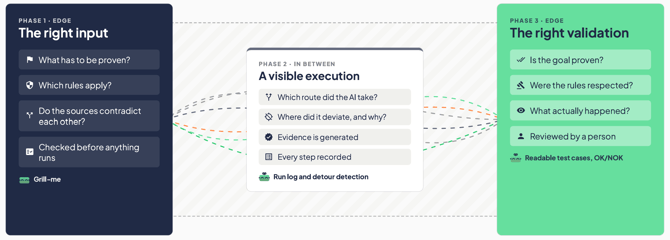
- Input: the Peripheral test case. You write the test goal and, optionally, a test plan, base steps, guardrails, data and requirements. Grill-me, an AI business analyst, helps you make it precise.
- Execution: the Peripheral execution. You click Start execution. An orchestrator (an AI session) takes your test plan and executes it test case by test case. For every part of a test case (a subgoal, such as "log in" or "create a claim") it starts a subagent: an AI session that operates the application with JOSF actions. JOSF records every passed step.
- Output: generated test cases. Every planned test case ends with an outcome: Passed, Finding or Aborted. You watch the recording, read the steps and decide: promote it to a traditional test case, mark the outcome as wrong, or add a guardrail for next time.
A generated test case is the result of one execution. Only when you promote it does it become a deterministic regression test: a traditional JOSF test case that plays back without AI.
What makes Peripheral different from "just asking an AI"
- The test plan leads. With a test plan, an execution runs exactly the test cases you planned, in your order, each one once. It never skips a test case on its own and never invents one; extra ideas come back as proposals you accept or reject.
- Only real verifications count. A test case can only end as Passed if it contains at least one passed verification step. It can only end as Finding if a verification step actually failed: what the AI merely "read" on a page is never a Finding.
- Every Finding has a source. A Finding must state where the expectation comes from (your test goal, a logical test step, a requirement, a ticket, ...), with a literal quote that JOSF checks. Without a valid source, JOSF refuses the Finding.
- Hard limits. The number of failed attempts per step, the ceiling per test case, the time-out in a playbook and the action set are enforced by JOSF, not left to the AI.
- Secrets stay secret. The AI only sees the alias of a secret, never its value. A central masking layer hides secret values in everything the AI reads and everything JOSF writes.
- Everything is visible. The run log shows what the AI thought and did; the Inputs tab shows exactly what it was given; the recording shows what the browser displayed.
- Peripheral learns, and you can correct it. Markings, guardrails, interventions and lessons carry over to the next execution, so every run starts smarter.
Key concepts
You will come across these concepts everywhere in the app and in this guide. The full list is in the Glossary.
| Concept | In short |
|---|---|
| Peripheral test case | Your input: test goal, test plan, guardrails, data, requirements and settings. It contains no executable steps. |
| Test goal | The one claim about the application's behaviour that has to be shown, true or false. |
| Test plan | The list of planned test cases. An execution runs exactly these. |
| Planned test case | One test case in the test plan: title, purpose, optional logical test steps. |
| Logical test steps | The rough steps a user takes, in plain text. They give direction, not exact steps. |
| Base steps / preconditions | Logical test steps every planned test case starts with, such as logging in. |
| Guardrail | A rule about what is and is not allowed during the test. |
| PRA level | How bad it is if the feature fails in production; it decides how broadly the AI tests. |
| Grill-me | An AI conversation that questions your test case and proposes improvements and a test plan. |
| Peripheral execution | One run in which the AI operates the application and creates generated test cases. |
| Generated test case | The steps that actually passed for one planned test case, with an outcome. |
| Outcome | Passed, Finding or Aborted. |
| Promote | Save a generated test case as a traditional test case that plays back without AI. |
| Marking | Your judgement that an outcome was wrong; it carries over to later executions. |
| Project knowledge | AGENTS.md, memory.md and glossary.md: what every execution reads and learns. |
Next: Getting started